

If you have ever asked how does video marketing work, you have probably found plenty of articles insisting that video matters and very few explaining the mechanism.
That gap is why so many businesses produce one polished marketing video, publish it, and conclude video does not work for them. It usually does. What fails is treating a single video as the strategy.
A Quick Answer
Video marketing works by matching video content to each stage of the buying journey and distributing it where your target audience already watches. Brands publish videos on social media platforms, landing pages, and email, then measure watch time, clicks, and conversions to prove return and improve the next video marketing campaign.
How Does Video Marketing Work, Step by Step
Most explanations of how video marketing works in practice stop at “make a video and post it,” which is why so many video marketing efforts stall.
The mechanism is actually a loop with four moving parts, and each one depends on the one before it.
1. Attention
Online video earns a moment of attention that text usually cannot. You often have only a few seconds before a viewer scrolls past, so the opening frame carries most of the weight. This is where short social media videos, vertical videos, and video ads do their work.
 2. Comprehension
 2. Comprehension
Once you have attention, video compresses explanation. A product or service that takes four paragraphs to describe can often be shown in forty seconds.
This is the job of explainer videos, product demo videos, and how-to videos. In Wyzowl’s 2026 survey, 93% of video marketers said video increased users’ understanding of their product or service, the highest-scoring outcome in the study.
3. Trust
Comprehension is not the same as belief. People buy from businesses they find credible, and video creates a personal connection that static visual content struggles to match, because viewers can see faces, hear tone, and read body language. Customer testimonials, brand video, and behind-the-scenes content all serve this stage.
4. Action and feedback
The video asks for one next step, and the platform reports what happened. That feedback loop is what separates video marketing from simply creating videos.
You learn which video style, video length, and message moved potential customers, and you build the next round of video campaigns on that evidence.
Skip any one of the four and the system breaks. Beautiful video footage with no call to action produces nothing measurable.
A hard sell without trust-building gets ignored. This sequencing is the entire answer to the question, and everything below is detail on how to execute each part.
What Is Video Marketing?
Video marketing is the practice of using digital video content to reach, educate, and convert a defined audience as part of your wider marketing strategies.
 It covers everything from a fifteen-second Instagram video to a ten-minute product demo, spanning owned channels such as your website, earned channels such as shares, and paid channels such as video ads.
It is worth being precise about scale, because the context explains why this format matters. Video is not one channel among many. It is the dominant form of content on the internet, and marketing has followed the audience there.
We have written separately on why video marketing is so powerful if you want the longer argument.
Video marketing is distinct from two things people often confuse it with. It is broader than video advertising, which is only the paid distribution piece.
And it is broader than video production, which is the craft of creating videos. Video marketing is the strategy layer that decides which videos to make, for whom, and what happens after they are published.
The Video Marketing Funnel: Matching Video Content to Buyer Stages
The single most common reason video marketing efforts underperform is a mismatch between the video and the viewer’s stage. Someone who has never heard of you is not ready for a pricing demo.
Someone comparing three vendors does not need a brand awareness piece. This table maps the format to the moment.
Video format by funnel stage, with typical length and the metric that matters
| Funnel stage | Viewer mindset | Best video format | Typical length | Primary metric |
|---|---|---|---|---|
| Awareness | Does not know you exist | Short social media videos, vertical videos, brand video, video ads | 15 to 60 seconds | Reach and 3-second views |
| Consideration | Has the problem, weighing options | Explainer videos, how-to videos, product videos, animated video | 60 to 120 seconds | Average watch time and view-through rate |
| Decision | Comparing you to alternatives | Product demos, customer testimonials, video testimonials, case studies | 2 to 5 minutes | Click-through rate and conversions |
| Retention | Already a customer | Onboarding and training videos, event videos, interactive videos | 3 to 10 minutes | Support ticket reduction and repeat purchase |
The length figures are not arbitrary. A business video found that videos under one minute retain roughly 65% of viewers to the end, while videos running over 20 minutes retain roughly 20%.
71% of respondents say videos between 30 seconds and 2 minutes are most effective. Longer content still has a place, but only where the viewer has already chosen to invest attention.
Our guide on how long a marketing video should be breaks this down by format.
Exploring the Different Types of Video Marketing
There are more video marketing content formats than most businesses need. The table below covers those that earn back their production costs most reliably and what each is actually good at.
Common video types, their job, and where they belong
| Video type | What it does | Best placement |
|---|---|---|
| Brand video | Communicates who you are and what you stand for, to increase brand awareness rather than drive an immediate sale | Homepage, About page, paid social |
| Explainer videos | Compresses a complex offer into a short, clear narrative. Wyzowl found 96% of people have watched an explainer video to learn about a product or service | Service pages, landing pages |
| Product demo videos | Shows the thing working, in sequence, so a buyer can picture using it. Wyzowl reported 80% of people have downloaded an app after watching a demo video | Product pages, sales email, demo request flow |
| Customer testimonials | Transfers credibility from a peer to you, which is the strongest signal at the decision stage | Pricing page, case study pages, retargeting |
| How-to videos | Earns attention by being useful first, and captures search demand from people solving a problem | YouTube, blog post embeds |
| Animated video | Explains abstract concepts, processes, or software that would be hard to film | Explainer slots, technical products |
| Live videos | Creates urgency and real-time interaction. Sprout Social notes LinkedIn Live sessions generate substantially more comments and reactions than standard native video | LinkedIn, Instagram, Facebook, YouTube |
| Behind the scenes content | Builds a personal connection and humanizes the brand, which supports trust at low production cost | Instagram, TikTok, Stories |
| Event videos | Extends the reach of a one-time event and creates a library of clips | Recap posts, sponsorship decks |
| Interactive videos | Lets viewers choose a path, useful for product configurators and training | Owned site, onboarding sequences |
You do not need all ten. A realistic starting library for most businesses is one brand video, two or three explainer videos covering your main offers, two customer testimonials, and a steady stream of short social media posts built from offcuts of that footage.
Benefits of Video Marketing, According to the Data
The benefits of video marketing are widely claimed and less widely evidenced, so the figures below are drawn from Wyzowl’s 2026 Video Marketing Statistics report, which surveyed 266 marketers and consumers in late 2025.
93% say video increased user understanding of their product or service
93% say video helped increase brand awareness
85% say video generated leads
83% say video directly increased sales
82% say video increased website traffic and dwell time
57% say video reduced support queries
Three of those deserve comment, because they are the ones people underuse.
Product understanding is the strongest effect
 Product understanding is the strongest effect
Understanding scores higher than sales in every version of this survey. That is a useful signal about where video earns its keep.
If your product is genuinely hard to explain, video is not a nice addition to your digital marketing campaigns; it is the most efficient tool you have. There are several practical ways to use video to build brand awareness once that foundation is in place.
Support reduction is a real and ignored benefit
The 57% who report fewer support queries are describing a cost saving, not a revenue gain, and it rarely appears in a video marketing plan.
A library of short how-to videos answering your ten most common questions pays for itself in deflected tickets alone.
Quality affects trust measurably
89% of consumers say the quality of a video affects how much they trust a brand. This does not mean you need a cinema budget.
It means the things video viewers actually notice, which are clear audio, adequate lighting and a script that gets to the point, are not optional. The ability to consistently create quality videos is less about equipment than about discipline, and the teams producing high-quality videos on modest budgets do so by protecting those three fundamentals rather than by buying better cameras.
Creating high-quality video content is a process question before it is a gear question.
Video is a powerful tool precisely because it does several jobs at once. It explains, it builds trust, and it is measurable. Very few marketing channels do all three.
How to Build a Video Marketing Strategy in 7 Steps
A video strategy is what turns scattered content into compounding results. Here is a video marketing plan you can run in a month.
If you are working with a small team or budget, our video marketing ideas for small businesses cover lower-cost options, and our video marketing for B2B covers longer sales cycles.
Step 1: Define one measurable business goal
Not “more visibility.” Pick a number you can check, such as thirty demo requests per month, a 20% lift in website traffic to a service page, or a measurable drop in a specific support ticket category. Everything downstream is judged against this.
Step 2: Define the target audience precisely
Write down who the video is for, what they already believe about your category, and the one objection the video must remove. Target customers who are skeptical need different video content than target customers who are simply uninformed.
Step 3: Choose the funnel stage and video format
 Step 3: Choose the funnel stage and video format
Use the funnel table above. Match one stage to one format. Resist the temptation to make a single video that tries to cover awareness, explanation, and closing at once, because it will do none of them well.
Step 4: Write the video script before anything else
Lead with the viewer’s problem in the first sentence, not with your company history. Keep one idea per scene. Read it aloud and cut anything that makes you bored. End with a single specific call to action, not three competing ones.
Step 5: Produce it
Capture clean video footage and, more importantly, clean audio. Shoot more coverage than you think you need so you can cut short social media videos from the same session. Edit to the shortest length that still makes the point.
Step 6: Distribute across every relevant channel
Upload natively to each platform rather than posting links; embed the video on the matching landing page and in a related blog post; add it to your email sequences; and cut vertical versions for Stories and Reels. One production session should yield eight to twelve distinct assets.
Step 7: Measure video performance and iterate
Give it three to four weeks, then look at view-through rate, engagement, and conversions. Kill what underperforms without sentiment. Make more of what works. This step is what makes the second round cheaper and better than the first.
Where most plans fail: steps 6 and 7. Businesses spend 90% of their budget on production and almost nothing on distribution and analysis. A modest video that is distributed and measured well will beat an excellent video that is posted once and forgotten.
Inside the Video Creation Process
Knowing the video creation process helps you brief a production partner well, and helps you spot where costs actually come from.
- Discovery and strategy. Goal, target audience, funnel stage, core message, success metric. Usually a single working session.
- Scripting and storyboarding. The video script is locked here. Changes after this point are the most expensive changes in the entire process.
- Pre-production. Casting, locations, scheduling, shot list, equipment. Unglamorous and the main determinant of whether the shoot day runs smoothly.
- Production. The shoot itself. Typically one day for a standard explainer or testimonial set.
- Post production. Editing, color, sound mix, motion graphics, captions. Captions are not optional, since a large share of social video is watched without sound.
- Versioning and delivery. Horizontal for YouTube and web embed, vertical for Reels, Shorts and TikTok, square for feed, plus short cutdowns for video ads.
- Launch and optimization. Publishing, thumbnails, titles, descriptions, schema markup and the first round of performance review.
Two practical points. First, budget for step 6 explicitly, because versioning is where a single shoot turns into a quarter of social media content.
Second, the fastest way to create video content affordably at volume is to batch, since three explainer videos shot in one day cost far less than three shot on three separate days.
Where to Publish Your Videos – Social Media Channels, Video Platforms and Beyond
Production without distribution is the most common and most expensive mistake in video marketing. This is also the point at which video marketing and social media marketing stop being separate disciplines, because the same asset must be reshaped for each destination.
Here is where the audience actually is, based on current platform data.
| Platform | What the data shows | What to publish |
|---|---|---|
| YouTube | Used by 82% of video marketers and rated most effective by 69%, the highest of any platform. 52% of users say short-form video is what they most interact with | Explainer videos, how-to videos, product demos, plus Shorts cut from the same footage |
| TikTok | 60% of users cite short-form video under 60 seconds as their most frequent interaction format, the highest of any platform | Vertical videos, behind-the-scenes content, quick tips |
| 52% of users most interact with short-form video. Statista data cited by Sprout shows Reels average markedly more shares than standard posts | Instagram videos, Reels, Stories, product videos | |
| 48% of users most interact with short-form video, and 22% interact most with live video | Live videos, customer testimonials, community content | |
| 27% most interact with short-form video, a lower share, but LinkedIn Live generates far more comments and reactions than standard native video | Thought leadership, event videos, B2B case studies | |
| Your own website | No algorithm between you and the viewer, and video supports the dwell time gains 82% of marketers report | Explainer on service pages, testimonials on pricing, demos on product pages |
| Consistently underused. Video thumbnails in email drive click-through to a hosted page | Product demos, onboarding, nurture sequences |
One rule applies across every one of these marketing channels. Upload natively rather than sharing videos as links to another platform, because every major network suppresses reach on posts that send users away.
If most of your distribution will be social, social media video production is worth planning as its own workstream rather than an afterthought to a larger shoot.
Video Marketing and SEO
Video affects your visibility in search engines through three separate mechanisms, and it is worth keeping them apart. Our dedicated guide to video marketing for SEO goes deeper on implementation.
Engagement signals on your own pages.
A relevant video keeps people on the page longer and reduces bounce. This is the mechanism behind the 82% of marketers who report increased website traffic and dwell time. It is indirect but real.
Direct visibility in search engine results pages.
 Direct visibility in search engine results pages.
Google surfaces video carousels and video rich results for many queries, particularly how-to and demonstration intents.
To be eligible, you need VideoObject-structured data, a descriptive title, a thumbnail, and, ideally, an on-page transcript. Most businesses embed video and never add the markup, which forfeits the opportunity entirely.
YouTube as its own search engine.
YouTube is a search destination in its own right, and its results also appear inside Google. Titles, descriptions, chapters and transcripts are your ranking surface there, so treat them with the same care you give a blog post title tag.
Add to this the newer consideration of AI search. Assistants such as ChatGPT, Gemini and Perplexity retrieve and cite passages rather than whole pages.
Publishing a transcript alongside your video gives those systems extractable text to quote, which a bare video embed does not.
Do you want a professional video marketing campaign? Zip In Media can help you to make it happen. Call us at 954-419-5673!
Video Marketing Examples Worth Studying
These video marketing examples are widely documented and illustrate distinct mechanisms rather than just large budgets. For examples of our own work across these formats, see the video portfolio.
Dropbox and the explainer video
Dropbox’s early explainer video is the canonical case for the format. The company faced a comprehension problem, since file syncing was unfamiliar to mainstream users at the time, and a simple animated video on the homepage explained the concept faster than any amount of copy.
The lesson is that explainer videos are the right tool when your barrier is understanding rather than desire.
Demonstration
Blendtec’s “Will It Blend?” series turned product demos into entertainment by blending unlikely objects. It works because it demonstrates the single product claim, which is raw power, in a way a specification sheet never could, and it does so in a format people wanted to share.
The lesson is that a demo video can carry a proof point and be genuinely watchable at the same time.
Short form repurposing
The most replicable modern example is not a single campaign but a habit. Businesses that shoot one longer interview or demo and cut it into fifteen to twenty short vertical clips consistently outperform businesses that produce one polished video per quarter.
Volume of relevant, engaging video content beats occasional perfection on nearly every social platform, because the algorithms reward consistent engaging content far more reliably than they reward a single polished release.
On viral videos: viral outcomes are worth studying but not worth planning around. They depend on timing and cultural context you cannot reliably reproduce. Build your video marketing strategy on formats that work predictably, and treat virality as upside if it happens.
How to Measure Video Performance
Measurement is where video marketing stops being a creative exercise and becomes a business one. The mistake is applying one metric to every video. Match the metric to the job.
Which metric to use for which video, and what it tells you
| Goal | Primary metric | What a poor result usually means |
|---|---|---|
| Increase brand awareness | Reach, 3-second views, share rate | Weak opening frame, or wrong audience targeting |
| Explain a product or service | View-through rate, average watch time | Script is too slow, or the video is longer than the idea requires |
| Generate leads | Click-through rate, form completions | Missing or vague call to action, or wrong funnel stage |
| Support a sale | Assisted conversions, sales cycle length | Not enough proof, or testimonials from the wrong customer profile |
| Reduce support load | Ticket volume in that category | Videos are not surfaced where customers actually look for help |
One diagnostic is worth more than the rest. Look at your audience retention graph and identify where viewers drop off. A steep fall in the first few seconds means the opening failed.
A steady decline throughout means the pacing is wrong. A cliff at a specific moment usually means you asked for something too early or said something that broke trust.
Five Mistakes That Undermine Video Marketing Efforts
- Making one video and calling it a strategy. A single asset touches one moment in a buying journey. Results come from a set that covers all three stages.
- Leading with the company instead of the viewer. “Founded in 2009, we are a full service provider” loses the audience in the first few seconds. Open with their problem.
- Ignoring sound-off viewing. A large share of social media videos are watched muted. No captions means no message.
- Using one edit everywhere. A horizontal 16:9 video posted to Reels performs poorly. Version the video format for each placement.
- Never checking the data. Without measurement, every subsequent video is a guess, and the cost of guessing compounds.
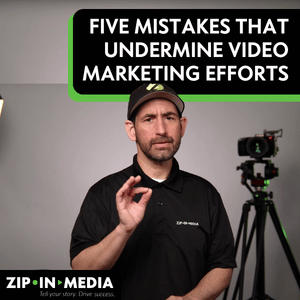 Making one video and calling it a strategy. A single asset touches one moment in a buying journey. Results come from a set that covers all three stages.
How This Changes by Industry
The four-stage mechanism is constant, but the emphasis shifts depending on what you sell and how regulated you are.
- Professional services. Trust does most of the work, so customer testimonials and founder-led video carry more weight than product demos. See video marketing for law firms for a worked example.
- Healthcare. Comprehension and credibility matter more than reach, and compliance constrains claims. Our guide to medical video marketing and our medical video production page cover the specifics.
- Financial services. Explaining complex products clearly is the main job, which makes explainer and animated formats disproportionately effective. See financial video production.
- Nonprofit. Emotional connection and storytelling drive donations more than feature explanation. See nonprofit video production.
Key takeaways
- 91% of businesses now use video as a marketing tool, and 82% report that it delivers positive return, according to Wyzowl’s 2026 survey of 266 marketers.
- Video marketing works through a sequence, not a single asset. Awareness, consideration, and decision each need a different video format.
- Length follows funnel stage. Vidyard benchmark data show that videos under 1 minute hold roughly 65% of viewers to the end, while videos over 20 minutes hold roughly 20%.
- Distribution matters as much as production. The same marketing video performs differently on YouTube, Instagram, and a landing page.
- The most commonly reported measurable outcomes are brand awareness, product understanding, and lead generation, in that order.
Ready to build your video marketing plan?
Zip In Media Productions produces brand videos, explainer videos, product demos, and customer testimonials for businesses in Miami, Fort Lauderdale, Boca Raton, and across South Florida. Tell us your goal, and we will tell you which videos will actually move it.
Let’s work together. Contact us at 954-419-5673!
How To Master Video Marketing and Where to Start
Mastering video marketing is less about production value than about sequence. Decide on the goal, know your target audience, match the video format to the funnel stage, distribute it effectively across your marketing channels, then analyze the data and do it again.
Businesses that treat video as a system rather than a series of one-off marketing campaigns are the ones that see compounding returns from their video marketing efforts.
If you are starting from zero, do not try to build the full library at once. Produce one explainer video for your most profitable service, put it on that service page, cut four short vertical clips from the same footage for social media, and measure what happens over the following month.
That single cycle will teach you more about how video marketing works for your specific business than any amount of further reading.
Frequently Asked Questions
How does video marketing work for small businesses?
It works the same way as it does for large businesses, but with tighter focus. Put them on the matching service pages, in email replies, and on your social media channels, then adjust based on what performs.
How much does video marketing cost?
Cost varies with production complexity rather than video length, so a single talking-head video with one camera and one location sits at the low end, while animated video, multi-location shoots, actors, and motion graphics push the number up.
Does video marketing help SEO?
Yes, both indirectly and directly: video increases time on page and reduces bounce.
What makes a video go viral?
Viral videos are an outcome, not a strategy, because they depend on timing and cultural context you cannot reliably reproduce. Build your video marketing strategy on repeatable formats such as explainer videos and customer testimonials, and treat virality as upside if it happens.
How many videos do you need before video marketing works?
More than one, because a single video only touches one moment in the buying journey. A practical starting set is one brand video, two or three explainer videos or product demos covering your main offers, and two customer testimonials, which cover all three funnel stages and give you enough data to see what your audience responds to.
