

I have spent 23 years producing video, and the role of a corporate video producer is still the part that most people misunderstand. That is not a criticism.
The job is genuinely hard to see from the outside, because almost everything a producer does well leaves no trace in the finished film.
Corporate videos are no longer a nice extra. Wyzowl’s 2026 survey found that 91 percent of businesses use video as a marketing tool, and 82 percent of marketers say it gives them a good return.
So the question is not really whether to make video. It is who will steer it.
91% of businesses use video as a marketing tool
82% of marketers say video gives good ROI
93% say video improved understanding of their product
Figures from Wyzowl’s State of Video Marketing 2026, based on a survey of 266 marketing professionals and consumers.
A Quick Answer
A corporate video producer plans, budgets, staffs, and delivers a company’s video project from first concept to final cut. Unlike a camera operator, who captures the footage, the producer owns the schedule, hires the production team, manages client approvals, and keeps the finished video aligned with the business goal.
What Is the Role of a Corporate Video Producer?
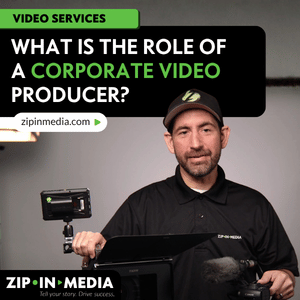
The role of a corporate video producer is to own the whole thing. Not the camera, not the edit. But the WHOLE THING, from the first conversation about what your business is trying to achieve through to the final file sitting on your website or your YouTube channel.
The way I describe it to clients is this. Everyone else on your project has a lane. The producer has the map.
 When the schedule slips, when the budget moves, when someone senior watches a rough cut and changes their mind about the whole direction, that lands on the producer’s desk. Nobody else’s.
Day-to-day, we wear many hats. I might spend a morning negotiating a location fee, an afternoon pulling apart a script, and the following week sitting with an editor arguing about whether a scene has earned its ninety seconds.
What never changes is the focus on the result. I am not trying to make something that looks impressive to other filmmakers.
I am trying to deliver a quality product that moves a number you actually care about, whether that is leads, conversion rates, training completion, or job applications.
“The producers I trust spend more time on the brief than on the set.”
That is the part most people miss, and it is why the producer plays such a key role. Before I think about cameras, I want to know who your target audience is, what they already think of you, what you want them to do differently after watching, and how we will both know whether it worked.
Every decision after that- the shot lists, the casting, the software, the final edit- comes out of those four answers. Skip them. And you get a video that looks fine and does nothing.
These professionals are behind compelling video content that reflects the brand’s identity and captivates the audience.
Not sure which one your project needs? Talk to our expert team at 1-954-419-5673!
Video Producer vs. Videographer vs. Director: Who Does What?
These titles get thrown around interchangeably, and honestly, that confusion costs companies real money.
People hire a camera operator when what they need is a producer, then wonder why they have 12 hours of footage that does not add up to a story. So let’s sort it out.
| Role | What they own | Hire them when |
|---|---|---|
| Video Producer | Budget, schedule, crew hiring, client communication, scripting oversight, and post-production delivery. Accountable for how it turns out. | You have several stakeholders, more than one shoot day, or a video tied to a business goal you have to report on. |
| Director | The creative call on set. Performance from professional talent, framing, tone, and pacing. Works closely with the camera department. | The project is scripted or uses on-camera talent, and it lives or dies on how the performance feels. |
| Videographer / Camera Operator | Running the video equipment and getting the footage. Often handles basic lighting and audio equipment on smaller jobs. | You need a single interview, event coverage, or straightforward filming, with the plan already settled. |
| Production Company | All of the above under one contract, plus the lighting department, sound design, video editing, and visual effects. | You would rather have one accountable partner than manage five freelancers yourself. |
On a small shoot, one person genuinely can cover two or three of these seats, and that is completely fine. The trouble starts when you assume that still works on a project that has outgrown it.
If your video involves several departments, a location you do not control, or an executive whose calendar is guarded by two assistants, you want someone whose only job is holding the pieces together.
What Does a Corporate Video Producer Do in Pre Production?
Pre-production planning is where the producer earns most of their fee. It is unglamorous and almost entirely invisible in the finished film, which is exactly why it gets cut first and regretted later.
 Discovery and strategy. Defining the objective, target audience, core message, and distribution plan across social media platforms, your website, and internal channels.
- Budget construction. Allocating money across crew, gear, talent, locations, and post-production, then protecting a contingency for the things that always come up.
- Scripting and storyboarding. Turning strategy into a script, then into shot lists that tell the crew exactly what needs to exist by wrap.
- Crew and casting. Booking the director, camera operator, boom operator, gaffer, production assistant and any professional talent. Checking that each person is a good fit for this particular project rather than just being available.
- Logistics. Locations, permits, insurance, release forms, call sheets, catering and the schedule that holds it together.
- Stakeholder alignment. Getting everyone who can say no to say yes before anyone picks up a camera.
What Does a Corporate Video Producer Do in Post Production?
Post production is where I have seen the most corporate video projects quietly die. The footage is in the can, everyone is tired, and the project drifts into three months of vague feedback rounds with nobody really steering.
The fix is unromantic. Set the rules early to avoid unnecessary issues and ensure everyone and everything is aligned with the KPIs.
I brief the editor against the original goal, agree up front how many revision rounds the budget covers, gather feedback from every stakeholder into one clear list instead of forwarding the editor six contradictory emails, and hold the delivery date.
Then there is the finishing work that turns raw footage into something you are proud to put your name on.
Remember that a YouTube master, a square cut for social, a captioned silent version, and a compressed file for your website are four separate deliverables from one project.
We plan for that on day one, because doing it the night before launch never goes well.
Tell us the goal, the deadline and roughly what you have to spend. If the honest answer is that you do not need us, we will say so. Book a call with us now!
What Skills Does a Corporate Video Producer Need?
The best producers I have worked with were rarely the most technical person in the room. But you need enough technical proficiency to make sensible calls.
And of course, to tell the difference between something that is truly impossible and something that is just inconvenient for whoever is telling you.
 The technical side
- A strong understanding of video equipment, audio equipment, and sound equipment, and roughly what each one costs to rent
- Enough familiarity with editing software and the post-production pipeline to talk sense with your editor, even if you never touch the timeline yourself
- Enough grasp of lighting and sound to catch a problem on set while it is still cheap to fix
- A working feel for how online content performs on each platform, from specs and aspect ratios to how fast people scroll away
The business side
- Budget management, including the willingness to say no early rather than overspend quietly and apologize later
- Communication skills sharp enough to translate between a marketing director and a colorist without either one feeling patronized
- Scheduling and logistics under pressure, in a work environment where the plan changes by the hour
- The judgment to bring ideas forward that serve your brand identity rather than the producer’s own showreel
- A real grasp of how a video connects to potential customers and turns into new clients
The essential tools keep changing. We run projects through cloud review platforms now, brief AI-assisted editing workflows, and track video performance in analytics dashboards that did not exist when I started.
Keeping up with the latest industry trends is part of the job. But a producer who chases every new format without asking what it does for your business is not adding much. I would say that to their face.
How to Harness the Power of Corporate Videos
Corporate videos are among the most effective tools for brand communication, but achieving real results requires a strategic approach. Video producers play a crucial role in this process because they understand the art of visual storytelling and know how to make a message land.
A good producer ensures that video content aligns directly with your brand’s goals and values, creating a seamless connection with your target audience.
To maximize the impact of corporate videos, they also stay ahead of the curve on new trends and technology.
This means staying informed about modern video production processes and adopting creative new techniques, including:
- Virtual reality
- Augmented reality
- Interactive elements
By continually testing new ideas, corporate video producers help elevate the viewer experience and keep audiences coming back for more.
How Do Video Producers Stay Ahead in the Digital Era?
Everyone in this industry tells you to keep up with the latest trends. Almost nobody tells you which ones are worth your time, so here is how I actually think about it after watching a lot of technology come and go.
 Start by separating the two halves of the job. The technology changes constantly. The craft barely moves at all. Cameras, editing software, and delivery formats have been reinvented several times since I started.
But what makes a video work? A clear idea, a reason for someone to keep watching, and a story that respects the viewer’s time have not changed in the slightest.
Producers who lose track of that end up with a folder full of impressive tools and nothing worth watching.
“Chase the fundamentals first. Chase the technology second.”
With that said, standing still is not an option either. The essential tools do move, and these are the parts genuinely worth your attention right now:
- AI-assisted post-production. Transcript-based video editing, automatic captions, rough-cut assembly, and cleanup tools have taken real hours out of our workflow. They handle the tedious passes. They do not make the creative calls, and I have not seen anything suggesting they will soon.
- Vertical and short form as a native format. Shooting so a video works cropped is a production decision, not something you fix in the edit. Frame for it on the day or you will regret it later.
- Platform specs and how people watch. Aspect ratios, caption defaults, and sound-off viewing on social media platforms change how you compose a shot. Most online content is watched muted, so if your message only lands with audio, it does not land.
- Analytics, not vanity metrics. Knowing where viewers actually drop off teaches you more about your craft than any equipment review will.
The parts I would not lose sleep over: every new camera body and any format trending this quarter with no clear connection to what your business is trying to do. I have watched producers rebuild their entire approach around a platform trend that disappeared within a year.
How I actually keep current
Nothing exotic. I rent unfamiliar gear for a single day before I ever consider buying it, so the learning happens on my time rather than a client’s.
 I keep working relationships with editors, colorists, and camera operators who are deeper in the technical weeds than I am, because a ten-minute call with the right person beats a week of reading.
And when we do try something new, we test it on internal work first, never on a client project with a deadline attached.
That last point matters more than it sounds. Adaptability in this business is not about adopting everything first. It is about being able to adapt to changes in the plan, the technology, or the brief without compromising the quality you promised.
Experimenting with an unconventional storytelling format is worth doing. Experimenting on the project your client is depending on is not.
Get a free, non obligatory quote!
Do You Need a Producer for a Small Video Project?
Not always. Any production company that tells you otherwise is selling to you. I would rather keep your trust than win one job you did not need.
You probably do not need a dedicated producer if you are filming a single talking head interview in one room, recording a straightforward event, or shooting something short with people who are already comfortable on camera. A good videographer with a production assistant will do that well.
You probably do need one if the project spans more than one shoot day or location, involves professional talent, needs sign-off from more than two stakeholders, has a hard external deadline, or is attached to a revenue target.
In those cases, a producer usually pays for themselves, mostly by preventing the reshoot nobody put in the budget.
How Do You Measure Corporate Video Success?
Views are the least useful number in video marketing. Do not rely on vanity metrics. All a view count tells you is that the video got distributed, not that it did anything for you.
Any producer who takes corporate video success seriously will want to agree on real metrics before production starts, because what you measure changes what we should make.
| Your goal | What to actually measure |
|---|---|
| Brand awareness | Reach, audience engagement rate, share rate, branded search lift |
| Lead generation | Click-through rate, form fills attributed to the video, cost per lead |
| Sales enablement | Conversion rates on pages with the video versus without, deal cycle length |
| Recruitment | Application volume, quality of applicants, offer acceptance rate |
| Internal training | Completion rate, comprehension scores, drop in support tickets |
Watch your retention curve above all. If most viewers drop at eleven seconds, your opening is the problem, and no amount of extra ad spend will paper over it.
The producers whose second video beats their first are simply the ones who go back and review the video performance data rather than moving straight on to the next job.
Once you have that baseline, interactive elements like chapters, in-video calls to action, and clickable end cards are worth testing.
Analytics and KPIs for Corporate Video Success
The success of corporate videos can be measured through analytics and key performance indicators (KPIs). Video marketing is one of the greatest tools in today’s digital landscape.
Incorporating them into your digital marketing strategy positions you at the top.
 Video producers need to monitor metrics such as:
- View count
- Engagement rate
- Conversion rates
These indicators assess the effectiveness of their productions. These insights gauge audience response and help make future content strategies.
Understanding the analytics behind video performance allows corporate video producers to refine their approach. The data gathered helps video producers tailor content to their target audience’s preferences.
This data-driven approach is integral to the iterative nature of digital marketing. Video producers can apply constant necessary refinement to sustained success.
What Are the Biggest Challenges in Corporate Video Production Today?
Most articles say the challenge is standing out in a sea of online content. True, but not much help. Here is what actually sinks projects, based on what I see.
Louder does not work. Narrower does. A video made for one type of buyer, in their words, about a problem they actually have, beats a polished general-purpose brand film almost every time.
Committee approval kills more good videos than tight budgets do. When a cut has to satisfy eight people, you get something nobody objects to, and nobody remembers. Agree who has final say before we shoot, not after.
Everyone wants more video for the same money. Fair enough, so plan for it. If we know on day one that you need a hero film, four social cuts, and a captioned silent version, we shoot all of it in one day. Reverse engineering nine deliverables from footage framed for one is where budgets disappear.
Most people watch with the sound off. If your message only lands with audio, it does not land.
As for new technology, use it when it solves a real problem for your audience. Skip it when it is impressive mainly to other filmmakers, and put the money into a better script.
Conclusion
The role of a corporate video producer in the digital age extends far beyond traditional videography. Video producers craft compelling brand narratives in our visual-centric world. They oversee the entire production process, from ideation to post-production refinement.
Video producers are a must-have if you want to stand out in today’s video-saturated market. Video marketing is an integral part of a successful digital marketing strategy.
Contact Zip In Media at 954-419-5673 and experience hassle free process.
The role of a corporate video producer should not be overlooked if you want successful video marketing.
Frequently Asked Questions
How long does a corporate video take from kickoff to delivery?
For a typical corporate video, plan on four to eight weeks. Roughly two to three weeks of pre-production, one to two shoot days, and two to four weeks in post.
What should I have ready before I call a video producer?
You do not need a script or a shot list, and you definitely do not need to know what camera you want. Come with the goal, who it is for, where it will live, and a rough budget range, and a good producer can take it from there.
What qualifications does a corporate video producer need?
A bachelor’s degree as the typical entry level education for producers and directors. A master’s degree is uncommon in this field. In practice, most hiring comes down to a portfolio of delivered work and references who confirm you hit your budget and schedule.
What does an assistant video producer do?
An assistant video producer supports the lead producer with call sheets, shot lists, release forms, location scouting, talent booking and equipment logistics. It is one of the most common ways people get started producing video content professionally.
