

I have been shooting corporate event videography in South Florida for more than two decades, and the question I get asked most is not about cameras. It is some version of “what am I actually paying for here?” Fair question.
From the outside, a video crew looks like a couple of people with tripods standing near the stage. What is really happening is a planned production with a pre-event phase, a shoot day, and a post-production phase, and each one shapes what you get back.
So this is the honest walkthrough, laid out as the questions people actually ask me. No pitch, no jargon. If you have never booked an event videographer before, start at the top and work down.
A Quick Answer
Corporate event videography is the practice of filming a company event and editing the footage into usable video. A crew covers keynote speeches, panel discussions, and candid interactions, then a post-production team cuts highlight reels and full sessions your marketing team can publish.
What Is Corporate Event Videography?
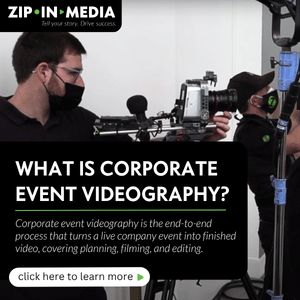
Corporate event videography is the end-to-end process that turns a live company event into finished video, covering planning, filming, and editing.
It is not just pointing a camera at a stage; it includes the pre-event consultation, the crew and gear on the day, and the post-production that follows.
 It is worth separating it from general event videography, which is a broader term that includes weddings, concerts, and private parties. Corporate work has different pressures.
There is usually a brand to protect, an executive whose delivery has to look sharp, a marketing team waiting on assets, and a room full of attendees who paid to be there. That changes how a crew moves, how they light, and how they edit.
If you are new to the category in general, it helps to understand how corporate films differ from advertising, since event work sits somewhere between the two. These are specialized videography services in that the skill set is highly specific.
Filming a keynote in a hotel ballroom with mixed lighting, pulling clean audio from a house soundboard, and staying invisible while doing it is a different job from filming a commercial on a controlled set.
Good event videography services are built around that constraint: one take, no resets, everything live.
The event formats this covers
Videographers film conferences, product launches, awards ceremonies, brand activations, trade show booths, town halls, and panel discussions. Event format drives nearly every production decision, so it is the first thing any good videographer will ask you about.
- Conferences and summits. Multi-day, multiple rooms, lots of sessions. Usually the most crew-intensive.
- Product launches. The reveal moment carries the whole video, so coverage is built around it.
- Awards ceremonies and galas. Low light, fast pace, emotional beats you cannot re-shoot.
- Brand activations and trade show booths. Heavy on B-roll, foot traffic, and reaction shots.
- Executive town halls and training sessions. Content-driven, often needing full unedited session recordings.
- Panel discussions and fireside chats. Two or three cameras minimum so the edit can cut between speakers.
Large-scale events at conference centers work differently from a fifty-person breakfast in a private dining room. Both are worth filming. They just need different plans.
Recognize your event in that list? Tell us the format and the date and we will tell you what coverage actually makes sense.
Why Should a Company Film Its Corporate Events?
Companies film corporate events because the event itself lasts a day and the video lasts all year. The footage becomes proof for next year’s sponsors, months of content for the marketing team, and a way to reach the audience who could not attend.
Most corporate clients I work with are after one or more of these:
 Proof for next year. A highlight reel is the single best tool for selling next event to sponsors and attendees. Nothing else conveys the energy and atmosphere of a full room, or lets you showcase a speaker lineup as convincingly.
- Content for the marketing team. One event can feed months of social posts, email headers, and website video if the footage is shot with that in mind. This is where event video production earns its keep as a marketing channel rather than a line item.
- Reach beyond the room. The people who could not attend still get the keynote. Your audience gets bigger than your venue.
- Internal record. Training sessions and town halls have real value as archives.
- Recruiting and culture. Candid interactions between colleagues sell a company culture better than any brochure.
 Proof for next year. A highlight reel is the single best tool for selling next event to sponsors and attendees. Nothing else conveys the energy and atmosphere of a full room, or lets you showcase a speaker lineup as convincingly.
The important part is deciding which of these you want before the event, because it changes what the crew shoots. A video meant for sponsors looks nothing like a video meant for internal training.
Pick a focus, share your vision for what the finished piece should feel like, and let the plan follow from it. That single choice does more to elevate the end result than any amount of gear.
Not sure what your event needs? That is normal, and it is what the first conversation is for. Tell us the format, the date, and what you want the video to do. We will tell you what coverage makes sense.
What Happens Before a Corporate Event Videography Shoot?
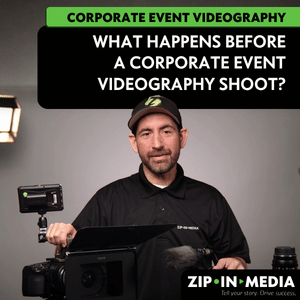
Before the shoot, there is a consultation, ideally a site visit, and a written shot plan. Most of the final video’s quality is determined in this phase, before anyone turns a camera on.
The initial consultation
The initial consultation is a working conversation about your run of show, your room, your speakers, and where the video will end up. If nobody asks you what the video is for, that is a warning sign.
A videographer with real production experience uses this call to work out crew size, camera count, and which sessions matter, rather than quoting you a package before understanding the event.
I have written separately about what a good production consultation should actually cover if you want to know what to expect before you get on the phone.
The site visit
 The site visit
A site visit tells the crew what the room actually does at the hour you are running, which no floor plan can show. We are checking where natural light falls, how house lighting affects skin tones, where power and audio feeds are located, and where a camera can live without blocking a guest.
Venues photograph very differently at 9 am and 7 pm. Walking the space in advance is how you find the best light instead of hoping for it.
The shot plan
A shot plan sets out how many cameras you have, where each one is positioned, which key moments are non-negotiable, and who gets interviewed and when. It turns video from a wildcard in your run-of-show into a scheduled element.
This is also where you find out whether drone footage adds anything or is just a nice idea the venue will not permit. Aerial work is more constrained here than most people expect, and our rundown of where drone flying is actually allowed across South Florida explains why.
Event planners tend to appreciate this step most, for obvious reasons.
A practical note for event planners: loop your videographer into the run-of-show document, not just the start time. Knowing that the CEO walks on at 2:15 and the award reveal happens at 4:40 is the difference between capturing a moment and hearing about it afterward.
How Does a Video Crew Cover a Corporate Event on the Day?
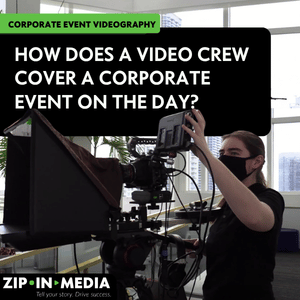
On the day, the crew works to the shot plan using multi-camera coverage, a dedicated audio setup, and continuous B-roll gathering. A well-planned crew looks calm on site, and calm is the whole point, because professionalism here means your attendees barely notice we are there.
Multi-camera coverage
Multi-camera coverage lets an editor cut between a speaker and an engaged audience, making a talk watchable rather than a static recording.
Most corporate events need at least two cameras – one locked on the stage for clean keynote speeches and one roaming to capture reactions and details.
On larger stages, a third camera gives you a tighter angle. For panel discussions, it is close to essential, because a single camera cannot follow four people trading lines.
Our longer guide to covering live events end-to-end goes deeper into how these setups are built.
Audio, which matters more than the picture
 Audio, which matters more than the picture
Audio matters more than the picture, without exception. People forgive imperfect images; they do not forgive a keynote they cannot hear.
We pull a feed from the house board whenever possible and run a backup recorder because a talk with unusable audio is one you cannot publish.
Cinematic b-roll
Cinematic b-roll is the supporting footage that connects the main moments: the registration desk filling up, hands on a product, a room going quiet before a reveal. It is what separates high-quality video from a security camera angle of a stage.
A crew should be gathering it throughout the day, not scrambling for it in the last hour. These are the shots that bring an event back to life for someone watching months later.
Interviews and candid moments
Yes, short on-site interviews with speakers, sponsors, and attendees are some of the most reusable footage you will get. We set up a quiet corner in the best nearby light and draw people in during breaks.
Alongside those, the candid interactions in hallways and at booths carry the real feel of the event. Visual storytelling lives in those moments more than in the scripted ones.
If customer interviews are the reason you are filming at all, our notes on getting a usable testimonial on camera are worth reading before the day.
Photography alongside video
Yes, images and video can be covered by the same crew when planned in advance. It is worth being clear about whether one person is doing both, because photography and videography pull in different directions in a fast-moving room.
Planning your next corporate event? Get the video conversation started early. Even a fifteen-minute call before your venue is locked in can change what is possible on the day.
What Happens After the Event in Post Production?
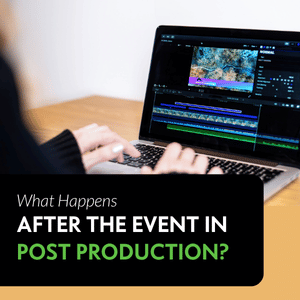
After the event, the post-production team syncs the multi-camera angles, colors the footage, mixes the audio, and cuts the deliverables agreed during planning. The goal is to create pieces your team can publish without further work.
This stage is invisible to everyone who attended, and it is where roughly half the value gets made. Our overview of how the edit suite fits into a South Florida production covers the process in more detail.
What normally gets delivered
You typically receive highlight reels, full session recordings, social cuts, and individual interview pieces. Raw footage is usually available on request, though it is worth confirming that in advance rather than assuming.
- Highlight reels. Usually the headline deliverable. A short cut that captures the energy of the day.
- Full session recordings. Complete keynote speeches and panel discussions, lightly edited, for on-demand viewing.
- Social cuts. Vertical and square versions sized for each platform, ready for immediate use by your marketing team. Worth deciding the run times up front, since the right length varies a lot by platform.
- Interview pieces. Individual speaker or sponsor cuts.
- Raw footage. Available on request.
 Highlight reels. Usually the headline deliverable. A short cut that captures the energy of the day.
Music and licensing
Yes, every edit should use properly licensed music, and this is not a detail to gloss over. Unlicensed tracks get videos muted or pulled on social platforms, and the takedown always lands at the worst possible moment.
Turnaround and final delivery
Turnaround depends on how much you shot and how many deliverables you want. For most events, our standard turnaround is one to three weeks from the shoot date.
A single highlight reel lands at the fast end of that window, while a multi-day conference with a dozen full session edits sits at the slow end. Faster turnaround is possible and typically carries an added charge, because it means staffing an editor against your deadline instead of a normal schedule.
If you need a same-week cut while the event is still trending, say so during planning, since that is a production decision rather than an editing one.
One thing worth knowing before you set expectations internally: editing usually takes three to five times longer than the shoot itself. A six-hour event is not a six-hour edit.
That ratio is why the delivery date is a planning conversation rather than an afterthought, and why a same-week social cut has to be agreed before the day rather than requested after it.
For larger corporate video projects outside of live events, our typical window runs a little longer, around three to four weeks, with exceptions made for urgent needs.
Final delivery should include a clear file handoff, the formats you requested, and no ambiguity regarding usage rights.
How Do You Choose a Corporate Event Videographer?
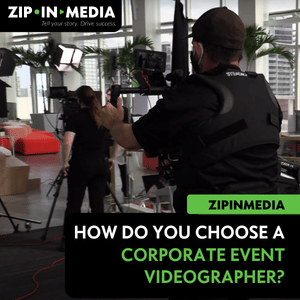
Choose a corporate event videographer on judgment rather than gear, because anyone can rent good cameras. Ask to see work from an event like yours, how many people will be on-site, and what their audio plan is.
A few questions that reveal a lot:
- “Can I see work from an event like mine?” A gala reel does not tell you much about how someone handles a three-day conference. Ask for the closest match.
- “How many people will actually be on site?” Crew size should follow the event, not a package tier, and it is the single biggest driver of what a videographer charges for an event.
- “What is your audio plan?” The answer tells you immediately how much event videography experience is in the room.
- “What happens if a camera fails at 2 pm?” Redundancy is not glamorous, but it is the whole job.
- “Are you insured for my venue?” Most conference centers require a certificate of insurance. Sort this early.
- “Who owns the footage?” Get it in writing.
- “What is the turnaround and what exactly do I receive?” Vague answers here become disappointing answers later.
 “Can I see work from an event like mine?” A gala reel does not tell you much about how someone handles a three-day conference. Ask for the closest match.
Extensive experience matters here in a specific way. It is not about years on a bio page. It is about whether someone has already solved the problem that is about to happen in your room, because something always does.
If you want to hear how we would handle the house board at your specific venue, we are happy to walk you through it.
What Makes Corporate Event Videography Work?
The events that produce the best video are almost never the ones with the biggest budget. They are the ones where somebody decided early what the video was for and told the crew.
Everything else- the camera count, the lighting, the interviews, the edit- follows from that one decision. If you are weighing this up for something on your calendar, start with the goal and work backward.
Let our team at Zip In Media handle everything from start to finish. Connect with us at 1-954-419-5673!
And when you are ready to put a plan behind it, we would be glad to help you think through corporate event videography for your next event.
Frequently Asked Questions
What is the difference between event videography and event video production?
In practice, they overlap heavily. Event videography typically refers to capturing what happens on the day, while event video production is the broader term encompassing planning, filming, and post-production.
Most companies offering one are really doing both.
How many videographers do I need for a conference?
It depends on how many rooms run at the same time. A single-track conference in one ballroom can work with two cameras, but the moment you have concurrent breakout sessions, you need a crew per room, or you have to choose which sessions go unrecorded.
Decide that during planning, not on the morning of.
Do you provide live streaming as well as recording?
Streaming and recording are related but separate builds, with different bandwidth and hardware requirements. If you want both, flag it during planning rather than on the day.
Our guide to live streaming video production covers the setup.
Can you include drone footage at a corporate event?
Sometimes, and it depends more on the location than the camera. Drone footage needs airspace clearance and venue permission, and much of South Florida sits under controlled airspace near airports.
It is worth asking about early rather than assuming.
Will the video crew be visible to attendees?
As little as possible. Dark clothing, planned camera positions, and movement during transitions rather than mid-sentence keep the crew in the background.
A good crew is felt in the final video and not noticed during the event.
What do you need from us before the event?
We need the run of show, a venue contact, the speaker list with the sessions that matter most, and any brand guidelines for graphics. Most importantly, a clear statement of what the video is for.
That is genuinely most of it.
Do you film corporate events outside Miami?
Yes. We cover Miami, Fort Lauderdale, West Palm Beach, Boca Raton, and the surrounding areas across Miami-Dade, Broward, and Palm Beach counties.
